Tuesday, June 1, 2010

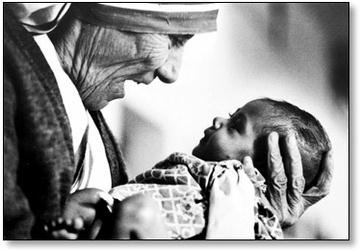
Mother Teresa and The Blessed Virgin


But Mother, I Have No Children
With only volunteer help, Mother Teresa was ministering to a large number of poor in various parts of Calcutta. Seeing the enormity of the need and wanting to do more, she implored the Virgin Mary to send her followers to further her work: I keep on telling her "I have no children" - just as many years ago she told Jesus "They have no wine" - I put all my trust in her Heart. She is sure to give me in her own way. (Journal, February 2, 1949) Her prayer was soon answered. Some of her former students from St Mary's were interested in Mother Teresa's new mission. She had already made an impact on them as their teacher, and now, in the example she was providing in this new life of Gospel service to the neediest they saw an ideal worth leaving everything to follow. On March 19, 1949, Shubashini Das, the future Sister Agnes, came to join her. During the following months more candidates arrived. By June 1950, the community numbered twelve. (...) Mother Teresa's accomplishments in little more than a year were remarkable.


Excerpts from Come Be My Light -

The Private Writings of the 'Saint' of Calcutta, Edited and with commentary by Brian Kolodiejchuk, M.C., Wheeler Publishing, (2008, pp 227-229).


MULTIMEDIA : Rodjenje Bogorodice

Monday, May 24, 2010

HER SMILE


Pentecost 1883: Our Lady's Smile


The illness was undoubtedly the work of the devil, who, in his fury at this first entry into the Carmel , sought revenge on me for the great harm my family was to do him in the future. However, he did not know that the Queen of Heaven watched over her Little Flower faithfully, that she smiled at her from above, ready to stop the storm, just in the nick of time when her delicate and fragile stem was in danger of being broken once and for all. At the end of the year 1882, I began to suffer from constant headaches; they were bearable, however, and did not prevent me from continuing my studies. They lasted till the Easter of 1883. Just then Papa went to Paris with Marie and Leonie , and confided Celine and me to the care of our uncle and aunt.
One evening I was alone with my uncle, and he talked so tenderly of my mother and of bygone days that I was deeply moved and began to cry. My sensitivity touched him too; he was surprised that someone of my age would feel as I did. So the he was determined to do all he could to organise all sorts of distractions during the holidays. But God had other plans. That same evening my headache became very acute, and I was seized with a strange shivering, which lasted all night. My aunt, like a real mother, never left me for a second. She stayed near me all through my illness with such tender, loving and devoted care. You may imagine my poor father's grief when he returned from Paris to find me in that hopeless state. He thought I was going to die, but Our Lord must have told to him: "This illness will not lead to death, it occurred for the glory of God." Yes, God was glorified by this trial. He was glorified by the admirable resignation of my father and sisters, especially Marie. She suffered so much because of me! How grateful I am to that dear sister! She seemed to know my needs by instinct, for a mother's heart is more powerful than the science of the ablest doctors. I do not know how to describe that strange illness. I said things which I had never thought of. I did things as though I were being forced in spite of myself. I almost always seemed to be delirious, and yet I feel certain that I was never, even for a minute, deprived of the use of my reason. Often I remained in a state of extreme mental exhaustion for hours, unable to make the slightest movement. However, in the midst of this extraordinary torpor, I distinctly heard what was being said around me, even the softest whisper. I remember it still.
And what fears the devil inspired in me! I was afraid of absolutely everything. My bed seemed to be surrounded by frightful precipices. Nails in the wall looked like terrifying long, shrivelled fingers, blackened by fire, making me scream in terror. One day, while Papa stood looking at me in silence, his hat in his hand suddenly turned into some sort of horrible shape, and I was so frightened that my poor father went away sobbing. In the moments when the pain was less intense, my great delight was to weave garlands of daisies and forget-me-nots for Our Lady. It was the beautiful month of May - all nature seemed to be clothed with spring flowers - the Little Flower alone drooped and seemed as though it had withered forever. Yet she too had a shining sun, the miraculous statue of the Queen of Heaven. How often, so very often, did the Little Flower turn towards that blessed Star! One day I saw Papa coming into my room in the deepest distress, and I watched him walk over to where Marie stood and give her some money, asking her to write to Paris, and have a novena of Masses said at the Shrine of Our Lady of Victories, to obtain the cure of his poor little queen. Ah, I was so touched by seeing his faith and his love! How much I longed to get up and tell him that I was cured! Alas, my desires could not work a miracle, and I needed a big one to restore my health. Yes, I needed a great big miracle, and Our Lady of Victories herself worked this miracle.
One Sunday, during the novena (Whit Sunday, 1883), Marie went into the garden, leaving me with Leonie, who was reading near the window. After a few minutes, I began to call softly: "Marie! Marie!" Leonie, accustomed to hear me moan like that, paid no attention, so I called louder, until Marie came back to me. I saw her come into the room quite well, but, at first, I did not recognize her. I looked around myself. I glanced anxiously into the garden, still calling: "Marie! Marie!" What unutterable anguish that forceful struggle was, and Marie perhaps suffered even more than her poor little Therese. Finally, after vain efforts to make me recognize her, she whispered a few words to Leonie, and went away pale and trembling. Soon my dear Leonie carried me to the window. There I saw the garden, but still I did not recognize Marie, who walked slowly, held out her arms, smiling at me, and calling me tenderly: "Therese, dear little Therese!" That last attempt failed again, my dear sister came in again and knelt at the foot of my bed in tears. She turned towards the statue of Our Lady, and pleaded her with the fervor of a mother who begs for her child's life. Leonie and Celine joined Marie in prayer, and that cry of faith forced open the gates of Heaven. I too turned to my Heavenly Mother, finding no relief on earth and nearly dead with pain, begging Our Lady from the bottom of my heart to have pity on me. Suddenly, the statue came to life! The Virgin became very beautiful, so divinely beautiful that I shall never find words to describe her. The expression of Our Lady's face radiated an ineffable gentleness, goodness, and tenderness, but what touched me to the very depths of my soul was her gracious smile. Then, all my pain vanished; two big tears welled up in my eyes and flowed silently. Ah, they were indeed tears of unmixed heavenly joy. "Our Blessed Lady has come to me, she has smiled at me. How happy I am, but I shall tell no one, or my happiness might disappear!" Such were my thoughts. Then, without any effort, I lowered my eyes, and I recognized my darling Marie. She looked lovingly at me, seemed very agitated, and she appeared as if she doubted the grace that I had just received. Ah, indeed thanks to her prayers I had received the most unfathomable favor - a smile from the Blessed Virgin! Seeing my eyes fixed on the statue, she said to herself: "Therese is cured!" Yes, it was true. The Little Flower had come back to life again - a bright ray from Our Lady's glorious Sun had warmed and set her free forever from her cruel enemy. "The dark winter is past, the rain is over and gone," and the Virgin Mary's Little Flower became so strong that five years later she opened wide her petals on the fertile mountain of Carmel.
Excerpts from: The Story of a Soul: The Autobiography of Saint Therese (Chapter 3)

MULTIMEDIA : Il ritratto di San Luca -(Rogier van der Weyden, Pablo Casals)

Hail Mary, full of grace, the Lord is with thee. Blessed art thou among women, and blessed is the fruit of thy womb, Jesus. Holy Mary, Mother of God, pray for us sinners now, and at the hour of death.

Saturday, May 15, 2010

MAY 16


ST. SIMON STOCK.
Feast Day: May 16th
SIMON was born in the county of Kent, England, and left his home when he was but twelve years of age, to live as a hermit in the hollow trunk of a tree, whence he was known as Simon of the Stock. Here he passed twenty years in penance and prayer, and learned from our Lady that he was to join an Order not then known in England. He waited in patience till the White Friars came, and then entered the Order of our Lady of Mount Cannel. His great holiness moved his brethren in the general chapter held at Aylesford, near Rochester, in 1245, to choose him prior-general of the Order. In the many persecutions raised against the new religious, Simon went with filial confidence to the Blessed Mother of God. As he knelt in prayer in the White Friars' convent at Cambridge, on July 16th, 1251, she appeared be fore him and presented him with the scapular, in assurance of her protection. The devotion to the blessed habit spread quickly throughout the Christian world. Pope after Pope enriched it with indulgences, and miracles innumberable put their seal upon its efficacy. The first of them was worked at Winchester on a man dying in despair, who at once asked for the Sacraments, when the scapular was laid upon him by St. Simon Stock. In the year 1636, M. de Guge, a cornet in a cavalry regiment, was mortally wounded at the engagement of Tehin, a bullet having lodge near his heart. He was then in a state of grievous sin, but had time left him to make his confession, and with his own hands wrote his last testament. When this was done, the surgeon probed his wound, and the bullet was found to have driven his scapular into his heart. On its being withdrawn, he presently expired, making profound acts of gratitude to the Blessed Virgin, who had prolonged his life miraculously, and thus preserved him from eternal death. St. Simon Stock died at Bordeaus, A.D. 1265.


Scapular of Mount Carmel
The Scapular of the Confraternity of Our Lady of Mount Carmel is brown in color, and often ornamented with pictures, which, however, are not essential. It owes its origin to Saint Simon Stock, an English Carmelite. Originally the investment with this scapular was restricted to the Carmelite Order, but now any priest having ordinary faculties in a diocese can invest with it. Saint Alphonsus Liguori died in 1787 wearing the Scapular of Mount Carmel. However, during the beatification process, when his tomb was opened, although the body of the holy bishop was found reduced to dust, and his clothes as well, his Scapular had remained perfectly intact! This precious relic is now housed at the Monastery of St Alphonsus in Rome. A century later, the same phenomenon of miraculous preservation of the Scapular was found when the relics of St John Bosco were examined.
Adapted from: A Garment of Salvation: The Scapular of Our Lady of Mount Carmel By a Monk of Saint Joseph Abbey (Flavigny, France)

Hail Mary, full of grace, the Lord is with thee. Blessed art thou among women, and blessed is the fruit of thy womb, Jesus. Holy Mary, Mother of God, pray for us sinners now, and at the hour of death. Amen.

Wednesday, May 5, 2010


Mary: A Role Model for Mothers


I imagine Mary holding Jesus like I did my babies, and bouncing him on her hip to keep him quiet as she's having a conversation. I imagine her doing everything I do with my kids--everything except for plugging her ears with her iPod to drown out the noise. I visualize her as the mom next door. Because in so many ways, that's what she was? In other words, Mary did the job of motherhood about as well as could anyone and she has much to teach us. Now I studied theology, but I still have a hard time comprehending the miracle of the Incarnation. However, Mary helps me to understand it better. The Trappist monk Thomas Merton wrote in his meditation: "Mary, who was empty of all egotism, free from all sin, was as pure as the glass of a very clean window that has no other function than to admit the light of the sun. If we rejoice in that light, we implicitly praise the cleanness of the window." I suspect therein is the hardest part of motherhood: to stay pure, to not get caught up in ego and self, so that we can hear the true desires of our children but also those of God. So I add Mary, the mother of Jesus to the list of great moms like Erma Bombeck, Marian Wright Edelman, and Jacqueline Onassis?

Adapted from an article by Therese J. Borchard See: www.beliefnet.com/beyondblue.


MULTIMEDIA : Пресвятая Богородице спаси нас!

Hail Mary, full of grace, the Lord is with thee. Blessed art thou among women, and blessed is the fruit of thy womb, Jesus. Holy Mary, Mother of God, pray for us sinners now, and at the hour of death.

Saturday, May 1, 2010


The Discovery of the "Treatise of True the Devotion" by Karol Wojtyla (Pope JP II)


The reading of this book marked a turning point in my life. I say "a turning point" although it was actually a long interior journey, coinciding with my clandestine preparation for priesthood. At this point in time this singular treatise came into my hands; it is one of those books that is not enough to have only just "read". I remember that I carried it for long time in my pocket, even taking it with me to the factory where I worked, so that its beautiful cover became stained with lime. I often thought about the passages and went back over them again and again. I quickly realized that there was something fundamental beyond the archaic manner of the book. From then onward, the Marian devotion of my childhood and even of my youth made way to a new attitude: a devotion that came from the deepest part of my faith, from the heart of a Trinitarian and Christological reality. Whereas before I always held back my love for the Virgin Mary in fear that my devotion to the Mother of God might mask Christ instead of yielding the way to Him, I came to understand in the light of the Treatise of Saint Louis de Montfort that it was actually the contrary. Our interior relationship with the Mother of God results organically from our bond to the mystery of Christ. It is therefore out of the question that one could prevent the other. (...) It is even possible to say that one who endeavors to know and love Jesus Christ designates Mary as his own Mother just as the disciple John did at Calvary.


Be Not Afraid!: John Paul II Speaks Out on His Life, His Beliefs, and His Inspiring Vision for Humanity, Andre Frossard in conversation with Pope John Paul II.

Translated from the French by J.R. Foster, 1984

MULTIMEDIA : Velankanni, India

Hail Mary, full of grace, the Lord is with thee. Blessed art thou among women, and blessed is the fruit of thy womb, Jesus. Holy Mary, Mother of God, pray for us sinners now, and at the hour of death. Amen.


May 2010
Title: Lectio: John 14,7-14
Saturday, May 1, 2010
Title: Lectio: 5th Sunday in Easter
Sunday, May 2, 2010
Title: Lectio: John 14,21-26
Monday, May 3, 2010
Title: Lectio: John 14,27-31a
Tuesday, May 4, 2010
Title: Lectio: John 15,1-8
Wednesday, May 5, 2010
Title: Lectio: John 15,9-11
Thursday, May 6, 2010
Title: Lectio: John 15,12-7
Friday, May 7, 2010
Title: Lectio: John 15,18-21
Saturday, May 8, 2010
Title: Lectio: 6th Sunday of Easter
Sunday, May 9, 2010
Title: Lectio: John 15,26 - 16,4a
Monday, May 10, 2010
Title: Lectio: John 16,5-11
Tuesday, May 11, 2010
Title: Lectio: John 16,12-15
Wednesday, May 12, 2010
Title: Lectio: John 16,16-20
Thursday, May 13, 2010
Title: Lectio: John 16,20-23a
Friday, May 14, 2010
Title: Lectio: John 16,23b-28
Saturday, May 15, 2010
Title: Lectio: The Ascension of the Lord
Sunday, May 16, 2010
Title: Lectio: John 16,29-33
Monday, May 17, 2010
Title: Lectio: John 17,1-11a
Tuesday, May 18, 2010
Title: Lectio: John 17,11b-19
Wednesday, May 19, 2010
Title: Lectio: John 17,20-26
Thursday, May 20, 2010
Title: Lectio: John 21,15-19
Friday, May 21, 2010
Title: Lectio: John 21,20-25
Saturday, May 22, 2010
Title: Lectio: Pentecost Sunday
Sunday, May 23, 2010
Title: Lectio: Mark 10,17-27
Monday, May 24, 2010
Title: Lectio: Mark 10,28-31
Tuesday, May 25, 2010
Title: Lectio: Mark 10,32-45
Wednesday, May 26, 2010
Title: Lectio: Mark 10,46-52
Thursday, May 27, 2010
Title: Lectio: Matthew 11,25-30
Friday, May 28, 2010
Title: Lectio: Luke 1,39-56
Saturday, May 29, 2010
Title: Lectio: The Most Holy Trinity
Sunday, May 30, 2010
Title: Lectio: Mark 12,1-12
Monday, May 31, 2010

Monday, April 26, 2010


Mary is a Woman who Loves


Outstanding among the saints is Mary, Mother of the Lord and mirror of all holiness. In the Gospel of Luke we find her engaged in a service of charity to her cousin Elizabeth, with whom she remained for "about three months" (1:56) so as to assist her in the final phase of her pregnancy. "Magnificat anima mea Dominum", she says on the occasion of that visit, "My soul magnifies the Lord" (Lk 1:46). In these words she expresses her whole programme of life: not setting herself at the center, but leaving space for God, who is encountered both in prayer and in service of neighbour - only then does goodness enter the world. (...) Mary's greatness consists in the fact that she wants to magnify God, not herself. She is lowly: her only desire is to be the handmaid of the Lord (cf. Lk 1:38, 48). She knows that she will only contribute to the salvation of the world if, rather than carrying out her own projects, she places herself completely at the disposal of God's initiatives. Mary is a woman of hope: only because she believes in God's promises and awaits the salvation of Israel, can the angel visit her and call her to the decisive service of these promises. Mary is a woman of faith: "Blessed are you who believed", Elizabeth says to her (cf. Lk 1:45).

The Magnificat - a portrait, so to speak, of her soul - is entirely woven from threads of Holy Scripture, threads drawn from the Word of God. Here we see how completely at home Mary is with the Word of God, with ease she moves in and out of it. She speaks and thinks with the Word of God; the Word of God becomes her word, and her word issues from the Word of God. Here we see how her thoughts are attuned to the thoughts of God, how her will is one with the will of God. Since Mary is completely imbued with the Word of God, she is able to become the Mother of the Word Incarnate.

Finally, Mary is a woman who loves. How could it be otherwise? As a believer who in faith thinks with God's thoughts and wills with God's will, she cannot fail to be a woman who loves. We sense this in her quiet gestures, as recounted by the infancy narratives in the Gospel. We see it in the delicacy with which she recognizes the need of the spouses at Cana and makes it known to Jesus. We see it in the humility with which she recedes into the background during Jesus' public life, knowing that the Son must establish a new family and that the Mother's hour will come only with the Cross, which will be Jesus' true hour (cf. Jn 2:4; 13:1). When the disciples flee, Mary will remain beneath the Cross (cf. Jn 19:25-27); later, at the hour of Pentecost, it will be they who gather around her as they wait for the Holy Spirit (cf. Acts 1:14).
Benedict XVI Deus est caritas # 41

MULTIMEDIA : En Ammaye Orkumbol Madhave (India)
MULTIMEDIA : Hristos Anesti

Hail Mary, full of grace, the Lord is with thee. Blessed art thou among women, and blessed is the fruit of thy womb, Jesus. Holy Mary, Mother of God, pray for us sinners now, and at the hour of death. Amen.